Tip Of AI
Discover what you can do with AI
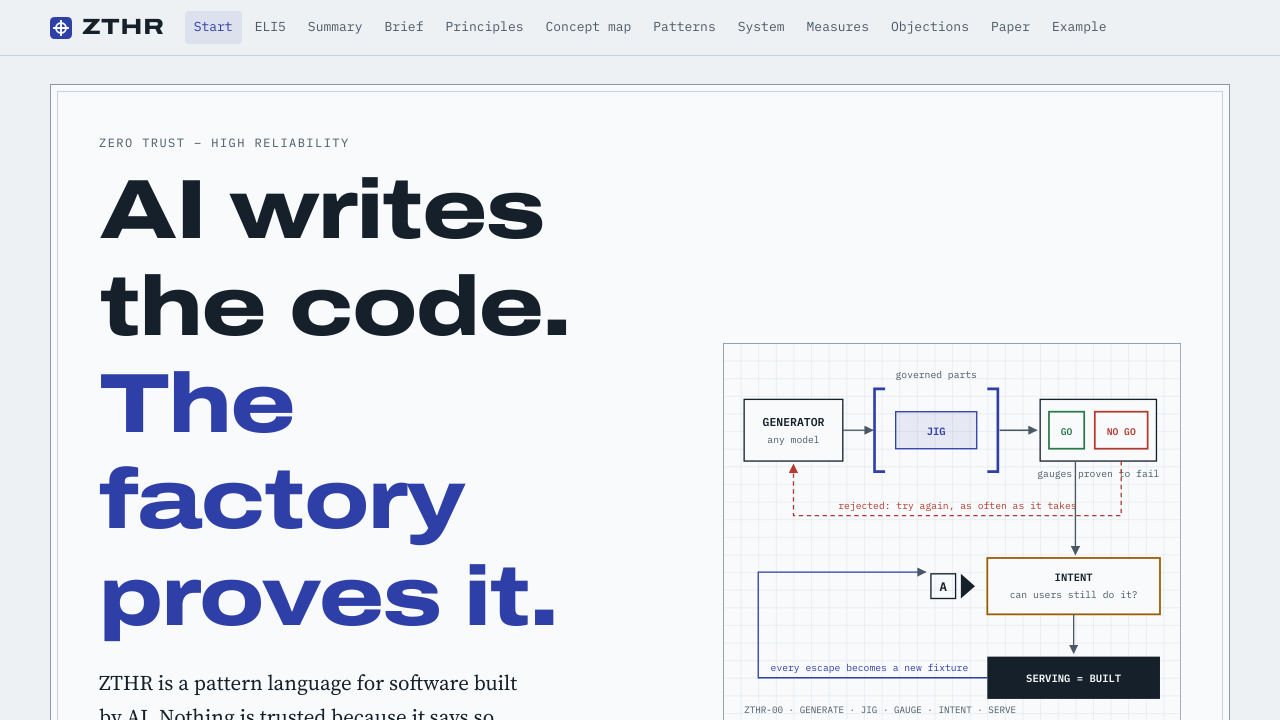
ZTHR stands for Zero Trust High Reliability and presents a pattern language for software built by AI. Its central idea is that AI should generate code while an independent software factory proves whether the result is acceptable. The approach moves quality away from the author and into the surrounding environment through governed foundations, qualified reusable parts, mandatory checks and user intent specifications. ZTHR uses two main principles called Symmetric Zero Trust and the Fixture Inversion. Symmetric Zero Trust means that no author, model, reviewer, test, operator or report can establish success merely by making a claim. Fixture Inversion means that quality should be enforced by the development environment rather than relying primarily on individual author skill. The framework includes thirty three patterns grouped into construction, verification, intent, independence, operational, and runtime and environment families. Features include bounded generation loops, mutation testing, independent model reviews, intent completion measurement, calibrated service twins, failure tracing, permission governance and automatic improvement of checks after defects. ZTHR includes a reference application, administrative tools, evidence records, documentation, source code, a discussion forum and an openly published paper by Russ Little. It is intended for autonomous software delivery, especially in regulated environments.