Tip Of AI
Discover what you can do with AI
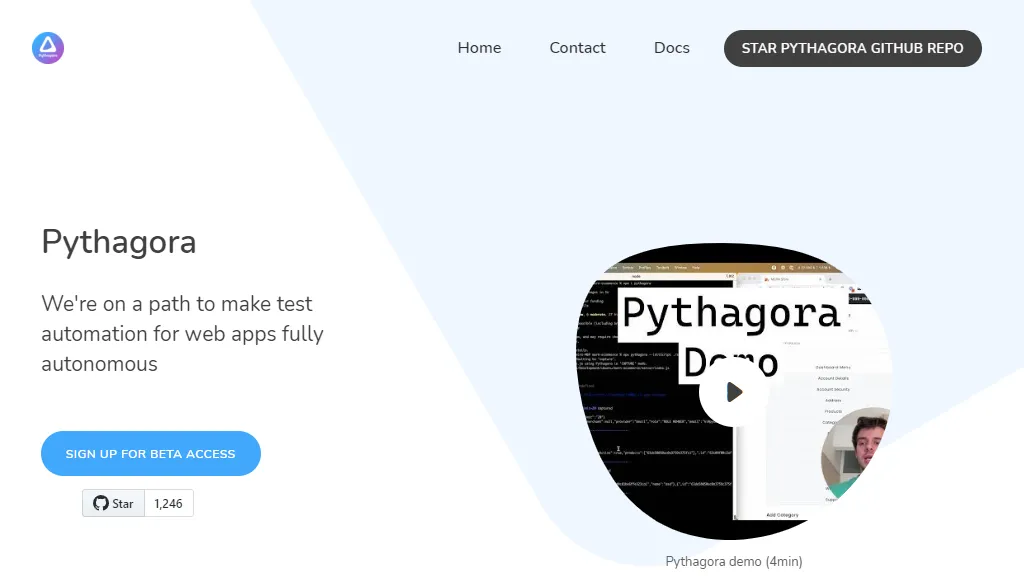
Pythagora is a tool that aims to make test automation for web apps fully autonomous. It offers a range of features that make test creation and execution easy and efficient. One of the key features of Pythagora is its super easy usage. To get started, users simply need to install Pythagora with npm. Then, they can run the capturing command to capture API requests, and finally run the test command to create tests. The tool leverages each API request to create a test, making test creation a quick and seamless process. In fact, Pythagora claims to achieve 0 to 80 code coverage in just 30 minutes. With Pythagora, developers can focus on working on the core codebase instead of spending significant time on writing tests. It acknowledges that developers often struggle to balance their time between writing tests and working on the codebase. Pythagora aims to alleviate this issue by enabling developers to prioritize codebase development without compromising the quality and coverage of tests. Pythagora also integrates with GPT-4 to generate Jest integration tests. It offers an intuitive workflow where users first install Pythagora, then run the capture command, make API requests using any preferred method (such as frontend, Postman, cUrl, etc.), and finally run the export command. In terms of how Pythagora works, it saves all server activity, including database queries and documents, during the test capture. When running the test, Pythagora restores the server state using a temporary Pythagora database, ensuring that the local database remains unchanged. This allows for consistent test execution across different environments. People interested in Pythagora can access helpful resources such as a tech deep dive video and documentation. They can also join Pythagora's community, which consists of over 2000 developers who believe in the tool's ability to simplify their lives. To learn more about Pythagora or get beta access, interested individuals can contact Pythagora via email. The tool is copyrighted by Pythagora, all rights reserved.