Tip Of AI
Discover what you can do with AI

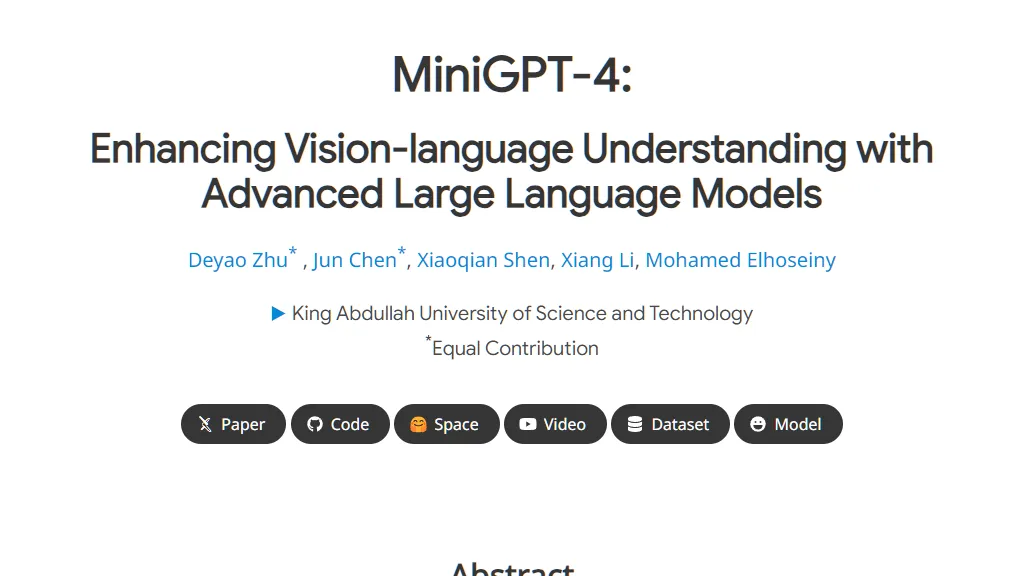
MiniGPT-4 is a model developed by Deyao Zhu, Jun Chen, Xiaoqian Shen, Xiang Li, and Mohamed Elhoseiny from the King Abdullah University of Science and Technology. It aims to enhance vision-language understanding using advanced large language models (LLMs). The model is built upon the success of GPT-4 and focuses on the utilization of an advanced LLM called Vicuna. MiniGPT-4 consists of a vision encoder that combines a pretrained Vision Transformer (ViT) and a Q-Former, a single linear projection layer, and the advanced Vicuna LLM. The vision encoder is aligned with the Vicuna LLM using the linear layer, which is the only part of the model that requires training. The researchers found that MiniGPT-4 exhibits similar capabilities to GPT-4, such as generating detailed image descriptions, creating websites from handwritten drafts, and identifying humorous elements in images. In addition, MiniGPT-4 showcases emerging capabilities like writing stories and poems inspired by given images, providing solutions to problems shown in images, and teaching users how to cook based on food photos. To address the issue of unnatural language outputs during pretraining on raw image-text pairs, the researchers curated a high-quality dataset in the second stage. They used a conversational template to finetune the model, improving its generation reliability and overall usability. One notable feature of MiniGPT-4 is its computational efficiency. The model is trained using only approximately 5 million aligned image-text pairs, making it highly efficient for deployment. The paper on MiniGPT-4, titled "MiniGPT-4: Enhancing Vision-Language Understanding with Advanced Large Language Models," was submitted to arXiv and is available for reference.