Tip Of AI
Discover what you can do with AI
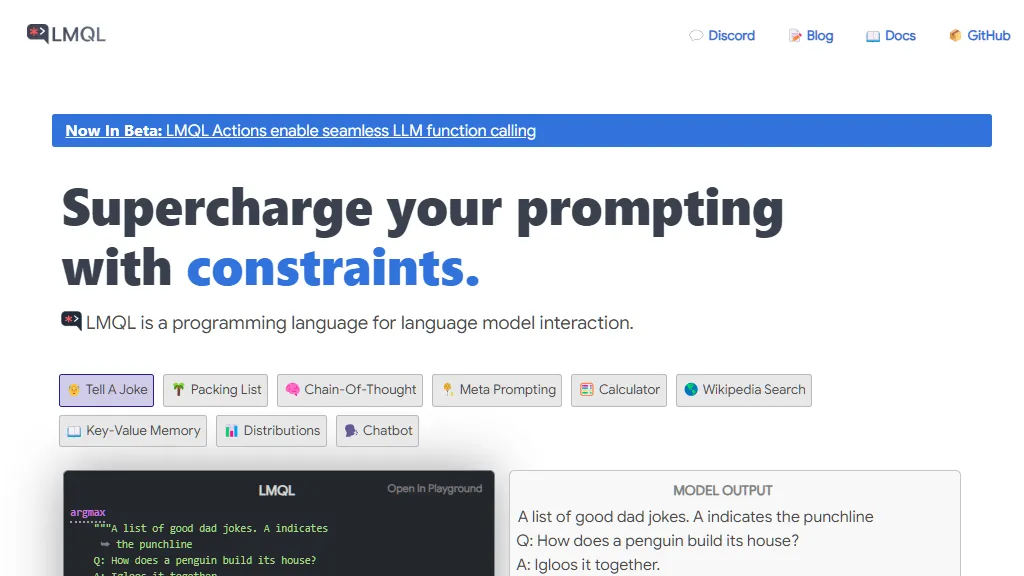
LMQL, or Language Model Query Language, is a programming language developed by the SRI Lab at ETH Zürich. It is designed for language model interaction and provides features that enhance the capabilities of language models. Some of the features and functionalities of LMQL include: 1. Seamless LLM Function Calling: LMQL enables the calling of Large Language Models (LLMs) functions in a seamless manner, enhancing the capabilities and interactions with the language model. 2. Supercharging Prompts: Users can supercharge their prompts using LMQL by utilizing various features such as constraints, debugger, decoders, transformers, templates, retrieval, and more. These features allow users to fine-tune the output of the language model according to their specific requirements. 3. Output Constraints: LMQL allows users to specify high-level, logical constraints on the language model's output. These constraints are automatically converted into token-level prediction masks, ensuring that the generated content satisfies the specified requirements. 4. Efficiency: LMQL offers significant efficiency gains over existing approaches by utilizing novel partial evaluation semantics. It can save up to 80% in consumed tokens compared to other methods while maintaining a high-level, declarative syntax. 5. Frontend/Backend Separation: LMQL provides a high-level frontend for interacting with language models, making the code portable and model-agnostic. The actual language model runs out-of-process or remotely, allowing for easy development and quick prototyping. LMQL is available in a web-based Playground IDE and can also be installed via the Python package manager. It provides a versatile and expressive way to interact with language models, making it more accessible and powerful for various applications. Feedback and contributions to LMQL are encouraged, and users can join the conversation through Community Discord, GitHub Issues, or Twitter.