Tip Of AI
Discover what you can do with AI

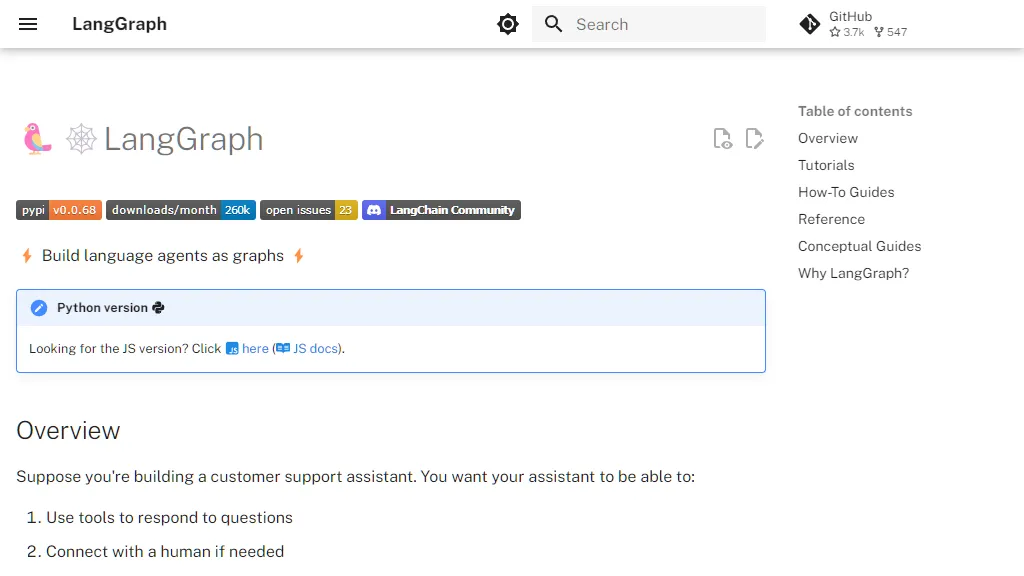
LangGraph is a powerful framework that allows you to build language agents as graphs. It provides a seamless way to create complex, stateful agents without the need for manual state and interrupt management. With LangGraph, you can define nodes, edges, and state schema, and let the graph take care of the rest. Key features of LangGraph include: 1. Graph-based Structure: LangGraph allows you to define your language agent as a graph, where nodes represent different components, such as the agent itself, tools, and user interactions. 2. Conditional Routing: LangGraph enables dynamic routing between nodes based on specific conditions. This allows for flexible and adaptive agent behavior. 3. Persistence: LangGraph comes with a built-in persistence mechanism that makes it easy to stop, resume, and rewind the agent at any point. This is particularly useful for long-running, multi-session applications. 4. Integration with NLP Models: LangGraph seamlessly integrates with natural language processing (NLP) models, making it easy to incorporate language understanding and generation capabilities into your agent. LangGraph is framework agnostic and can be used with any Python-based application. It extends the core Runnable API to provide additional functionality for stateful, nonlinear flows. To get started with LangGraph, you need to install it using pip and define your assistant using the provided APIs. The framework offers tutorials, how-to guides, and a comprehensive reference documentation to help you build and deploy your language agent effectively.