Tip Of AI
Discover what you can do with AI
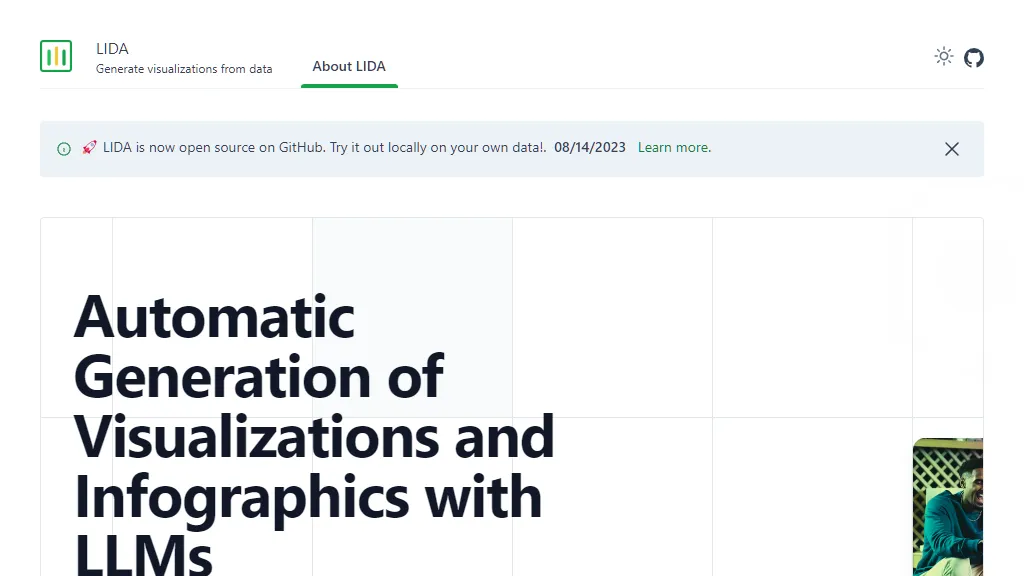
LIDA (Language-based Infrastructure for Data Analytics) is an open-source tool developed by Microsoft Research that enables the automatic generation of visualizations and infographics from data. It leverages large language models (LLMs) and image generation models (IGMs) to address the various subtasks involved in visualization creation. LIDA consists of four modules: the Summarizer, Goal Explorer, VisGenerator, and Infographer. The Summarizer converts data into a concise natural language summary, providing context for subsequent operations. The Goal Explorer generates visualization goals based on the dataset, offering automated data exploration. The VisGenerator generates, refines, executes, and filters visualization code, supporting various programming languages and visualization grammars. Lastly, the Infographer uses IGMs to produce stylized and engaging infographics based on the data. The tool offers a Python API and a hybrid user interface that supports both direct manipulation and multilingual natural language input, facilitating interactive chart creation, infographics generation, and data storytelling. In terms of features, LIDA enables data summarization, automated data exploration, grammar-agnostic visualizations (supporting various visualization grammars and programming languages), infographics generation, visualization explanation, self-evaluation, visualization repair, and visualization recommendations. It also incorporates the best practices encoded in state-of-the-art LLMs for multi-dimensional evaluation of visualizations. LIDA has some limitations, such as potential issues with visualization grammars that are not well represented in the LLM's training dataset and performance variations depending on the similarity of the dataset to example datasets available online. Additionally, LIDA requires code execution and a sandbox environment is recommended for safe execution. The tool's system architecture involves the integration of LLMs and IGMs to generate visualizations. The paper detailing LIDA's capabilities and architecture has been accepted for publication at the 2023 ACL Conference (System Demonstrations). Overall, LIDA provides an advanced infrastructure for automating the visualization process, making it more accessible and efficient for data analysis and storytelling.