Tip Of AI
Discover what you can do with AI

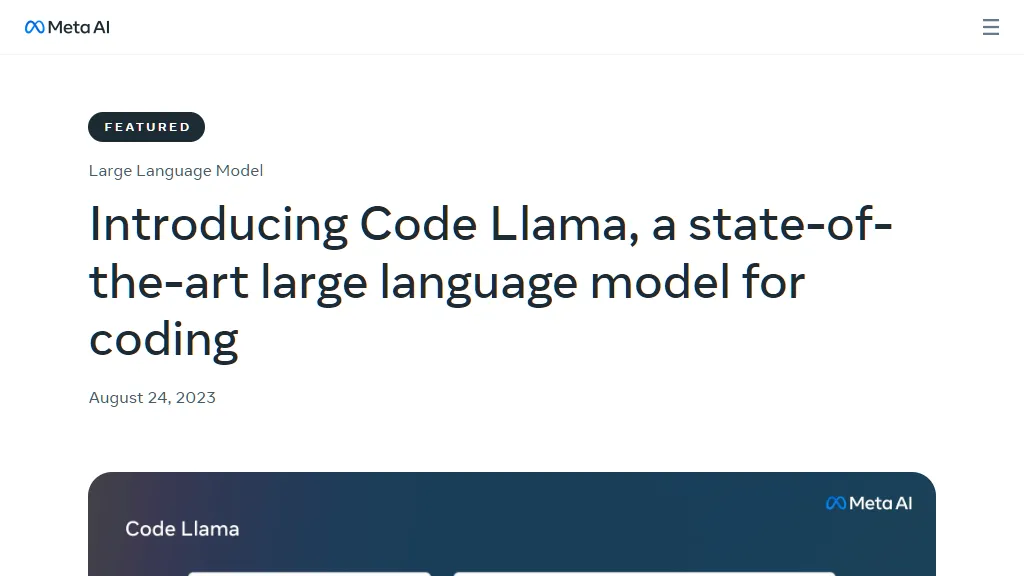
Code Llama is a state-of-the-art large language model (LLM) specifically designed for coding tasks. It is capable of generating code and natural language about code from code and natural language prompts. Code Llama is free to use for both research and commercial purposes. It is built on top of Llama 2, another large language model, and is available in three models: Code Llama (the foundational code model), Code Llama - Python (specialized for Python), and Code Llama - Instruct (fine-tuned for understanding natural language instructions). In benchmark testing, Code Llama outperformed other publicly available LLMs on code tasks. It has the potential to make coding workflows faster and more efficient for developers and lower the barrier to entry for those learning to code. Code Llama is available in three sizes: 7B, 13B, and 34B models, each trained with 500B tokens of code and code-related data. The models support popular programming languages like Python, C++, Java, PHP, Typescript (JavaScript), C#, and Bash. Code Llama's models provide stable generations with up to 100,000 tokens of context. The 7B and 13B models have fill-in-the-middle (FIM) capability, allowing them to insert code into existing code for tasks like code completion. The smaller models are faster and suitable for tasks requiring low latency, while the 34B model provides the best results and enhanced coding assistance. Additionally, Code Llama offers two fine-tuned variations: Code Llama - Python, specialized for Python code generation, and Code Llama - Instruct, which is fine-tuned for understanding natural language instructions. To evaluate Code Llama's performance, benchmark tests were conducted using coding benchmarks such as HumanEval and Mostly Basic Python Programming (MBPP). Code Llama outperformed other open-source code-specific LLMs and achieved comparable scores to ChatGPT. Meta, the organization behind Code Llama, believes in responsible use of AI models and has taken safety measures to ensure Code Llama generates safer responses. Red teaming efforts were conducted to assess the model's risk of generating malicious code, and Code Llama performed better than ChatGPT in terms of safety. Code Llama is released with the aim of improving developer workflows and facilitating the development of new technologies. The entire community is invited to evaluate the model's capabilities, identify issues, and contribute to fixing vulnerabilities. Developers are encouraged to evaluate their models using code-specific evaluation benchmarks and perform safety studies on code-specific use cases. Meta provides guidance on responsible use and offers resources for evaluating, fine-tuning, and addressing risks in AI models. Code Llama is designed to support software engineers in various sectors, and Meta hopes that its release will inspire others to create innovative tools using Llama 2. The Code Llama models, training recipes, and model weights are available on Meta's GitHub repository. By releasing Code Llama and adopting an open approach, Meta aims to promote innovation and safety in the generative AI space, ultimately benefiting developers and improving their coding experiences.